
.svg)
.svg)

.png)
.png)

If you're comparing TestSigma pricing against other options, you're probably weighing cost against long-term maintenance. The real expense isn't the subscription fee. It's the engineering hours spent updating brittle selectors every time your frontend team ships a change. DOM-based tools lock you into a cycle where tests fail not because your app is broken, but because an attribute changed.
TLDR:
- TestSigma uses DOM-based selectors that break when frontend code changes, requiring constant maintenance
- Vision-based tools like Docket use coordinates instead of selectors, eliminating test failures from UI updates
- TestSigma locks you into their platform with no export options, forcing a full rewrite if you migrate
- Autonomous AI agents adapt to application changes in real-time without manual script updates
- Docket tests complex UIs through visual analysis, avoiding the brittleness of attribute-dependent automation
What Is TestSigma and How Does It Work?
TestSigma operates as a cloud-native test automation system designed to unify testing for web, mobile, API, and desktop applications. The tool allows teams to write automated tests using natural language statements rather than code. By parsing English instructions, it translates manual test cases into executable scripts, making automation accessible to subject matter experts and manual testers who may lack deep programming skills.
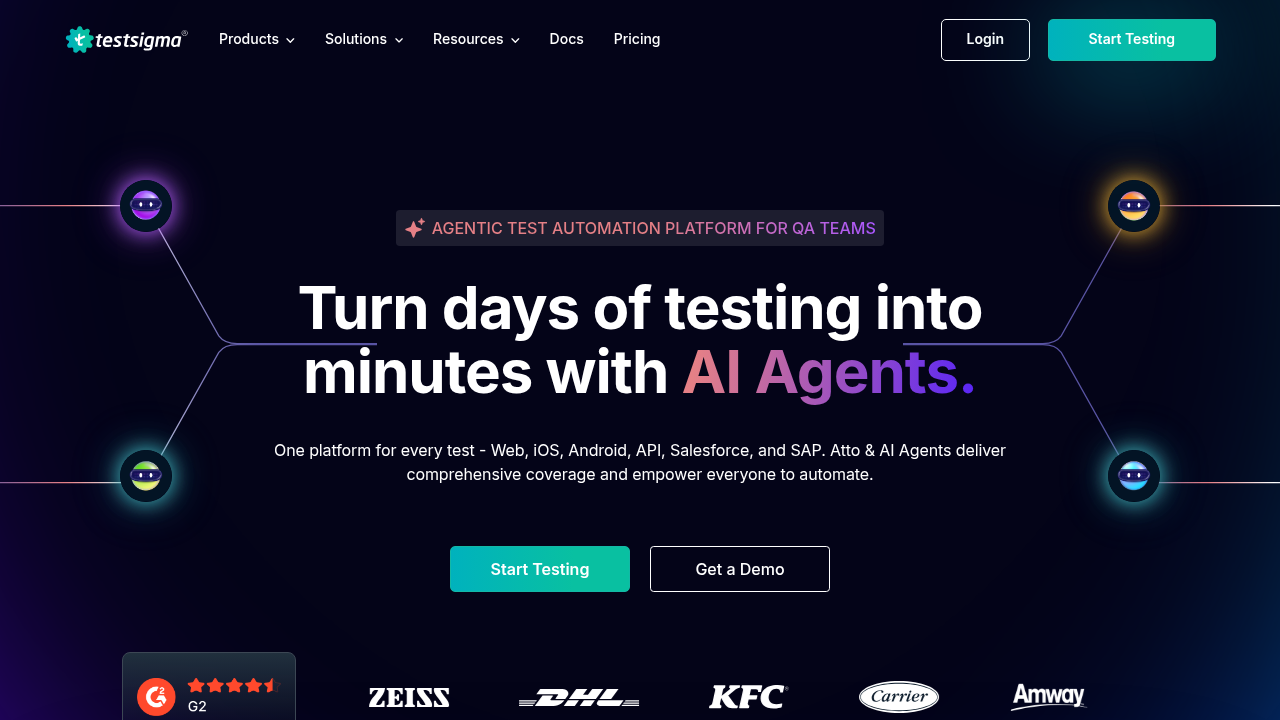
At a technical level, TestSigma relies on DOM-based element identification. When a user defines a step, the recorder captures attributes within the application's Document Object Model such as IDs or XPaths to locate elements. The system runs these tests on distributed cloud infrastructure, enabling teams to execute suites across multiple browsers and device combinations in parallel without managing local servers.
TestSigma includes AI-driven features to mitigate the brittleness of DOM-based automation. The system uses self-healing algorithms that monitor element attributes; if a specific selector changes due to a UI update, it attempts to identify the element using alternative attributes. The tool also provides AI assistance for generating test steps and data to support regression coverage.
Why Consider TestSigma Alternatives?
TestSigma targets enterprise teams prioritizing low-code workflows. It functions via natural language inputs to build automation. However, even as 72% of organizations have implemented some level of test automation in 2025, engineering leads often hit architectural ceilings that restrict long-term scale. Teams scaling with TestSigma frequently encounter specific hurdles.
Key Technical Limitation:
- Vendor Lock-in: The system prevents exporting tests to standard code formats like Playwright or Selenium. Migrating away necessitates a complete rewrite of the test suite.
- DOM-Based Fragility: Reliance on element attributes creates instability with deeply nested DOMs or frequent frontend updates. It lacks the resilience of vision-first systems that analyze the UI visually.
- Data Handling: Managing sophisticated logic or extensive parameterization proves difficult, often forcing teams into rigid workarounds that slow velocity.
- Cost Structure: Custom scenarios frequently demand heavy maintenance. Essential features often reside behind paywalls, inflating the total cost of ownership compared to open frameworks.
Organizations seeking autonomous AI runs or coordinate-based validation often find these dependencies restrictive, prompting a move toward tools offering zero lock-in and visual analysis.
Best TestSigma Overall Alternative: Docket
Teams replace TestSigma primarily to escape the maintenance loop created by brittle selectors. While TestSigma parses natural language, the execution relies on the DOM. Tests fail when code attributes shift. The following list ranks options by architectural resilience.
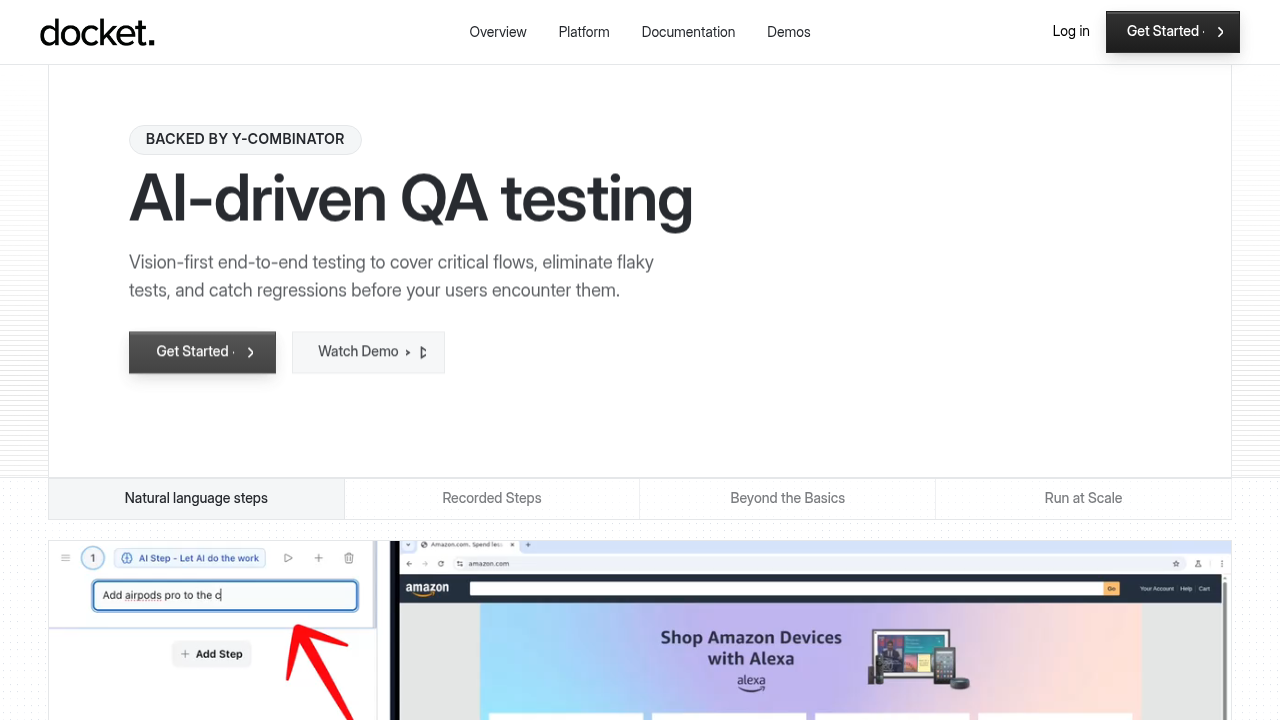
Docket shifts QA from DOM reliance to vision-based automation. Unlike tools hooking into code attributes, Docket uses AI agents to view and interact with screens via coordinates. This approach removes failures caused by renamed IDs, nested divs, or dynamic classes.
Key features:
- Vision-only analysis ignores code selectors.
- Autonomous agents complete objectives and detect UX friction.
- Natural language inputs generate resilient test flows.
- Maintenance drops as agents adapt to visual changes.
Good for:
Engineering and QA teams that need stable, low-maintenance, end-to-end web and mobile flows (including complex UIs and third-party widgets) to keep up with frequent releases.
Limitation:
Best suited to visually-rendered interfaces; deeply API-only or backend-heavy scenarios still need complementary non-visual tests.
Bottom line:
Docket replaces selector brittleness with vision-first autonomous agents, giving teams durable coverage over fast-changing products without the script and locator maintenance overhead of DOM-based tools.
Tricentis
Tricentis targets enterprise environments, using model-based testing for stacks like SAP and Salesforce. It helps prioritize risk in massive suites but remains tethered to object properties. The reliance on the DOM limits agility compared to visual agents, making it better suited for legacy requirements than web-first products.
Key features
- Model-based testing geared toward large enterprise stacks (e.g., SAP, Salesforce) and complex business processes.
- Risk-based prioritization and broad support across web, desktop, and packaged apps with deep enterprise integrations.
Good for:
Enterprises with heterogeneous application portfolios and regulated workflows that need risk-based, model-driven validation across legacy and packaged systems.
Limitation:
Relies on object properties and DOM-style identification for web UIs, which can become brittle and slow to adapt in modern, rapidly changing frontend stacks.
Bottom line:
Tricentis excels at enterprise-wide, model-based regression, but its DOM/object dependence makes it less agile than vision-first agents for fast-moving, web-first products.
Mabl
Mabl offers a low-code cloud environment with a recorder interface. While it includes visual change detection, the underlying execution is DOM-based. Self-healing features are reactive, requiring a failure before attempting repair, which creates noise in CI pipelines.
Key features
- Cloud-hosted low-code platform that combines UI and API testing with a visual recorder and central reporting.
- DOM-based auto-healing that attempts to repair broken selectors using historical runs, plus CI/CD integrations.
Good for:
Teams that want an all-in-one, managed, low-code environment for combined UI/API testing and can tolerate some selector maintenance as their app evolves.
Limitation:
Execution still hinges on DOM selectors, so frequent frontend changes and complex UIs can produce flaky tests and ongoing healing/maintenance cycles.
Bottom line:
Mabl streamlines initial test creation and hosting, but its selector-first architecture makes long-term stability harder than with coordinate-based, vision-driven systems.
Stably AI
Stably AI accelerates script writing by generating Playwright code from text prompts. While useful for initial setup, the output acts as standard code. It inherits selector brittleness, leaving the long-term maintenance burden on the engineering team.
Key features
- Generates Playwright test scripts from natural language prompts, accelerating code-based test authoring.
- Fits directly into existing Playwright and CI/CD pipelines by outputting standard test code.
Good for:
Engineering-heavy teams invested in Playwright that want to speed up authoring while keeping full control over code-based tests.
Limitation:
Outputs conventional selector-based scripts, so tests remain vulnerable to DOM and attribute changes and inherit typical Playwright maintenance overhead.
Bottom line:
Stably AI makes writing brittle scripts faster; it does not remove the underlying selector fragility that vision-first agents are designed to eliminate.
Spur
Spur focuses on e-commerce with pre-configured steps for retail flows. It lacks autonomy, requiring users to manually specify inputs. It fits basic storefronts but struggles with custom logic or unique application workflows.
Key features
- E-commerce-focused flow capture and replay for store, cart, and checkout scenarios.
- Preconfigured patterns tailored to common retail journeys to speed up coverage.
Good for:
Online retailers with relatively standard storefronts who want vertical-specific automation and are comfortable defining explicit steps for key flows.
Limitation:
Relies on manually specified, DOM-based paths without autonomous agents, so it struggles with highly customized logic and rapidly changing, dynamic interfaces.
Bottom line:
Spur aligns well with straightforward retail flows, but its step-driven, selector-based model makes it less adaptive than coordinate-based AI agents for complex or frequently updated UIs.
ContextQA
ContextQA integrates deeply with JIRA and Jenkins to link failures to defects. The engine uses reactive DOM healing and manual step definitions. While it organizes reporting, it does not prevent upstream breakage caused by dynamic frontends or UI updates.
Key features
- Session recording and step-based test creation that link failures to issues in tools like Jira and CI systems.
- Centralized reporting and analytics over recorded flows and regressions.
Good for:
Teams that value strong defect traceability and reporting, and prefer recording click-by-click flows tied into their existing DevOps stack.
Limitation:
Uses DOM selectors with reactive healing and manual steps, so dynamic frontends and frequent UI changes still generate flakiness and maintenance work.
Bottom line:
ContextQA improves traceability between tests and tickets, but it does not solve the root selector brittleness problem that vision-based, autonomous tools address at the architectural level.
Feature Comparison: TestSigma vs Top Alternatives
Selecting a QA tool requires analyzing the underlying interaction model. Most solutions, including TestSigma, rely on DOM parsers and selectors. The data below compares technical capabilities across TestSigma, Docket, and other ecosystem players.
Why Docket Is the Best TestSigma Alternative
TestSigma is a functional entry point for codeless automation but ties tests to DOM selectors (IDs, classes, XPaths), so UI changes often break flows and create significant maintenance overhead for scaling teams. Docket avoids this fragility with vision-first, coordinate-based agents that visually interpret the interface, self-correct as components move, and emphasize data portability instead of vendor lock-in, giving teams a more stable and flexible foundation for long-term QA strategy.
Final Thoughts on Selecting the Right Testing Tool
When you compare TestSigma alternatives, the testing approach matters more than the feature list. DOM-based tools require constant upkeep as your application changes. Vision-first automation removes that dependency by treating your UI as a visual surface. Your tests should adapt to changes, not break because of them. The industry is moving in this direction: Playwright adoption reached 45.1% in 2025 while Selenium dropped to 22.1%, reflecting a broader shift toward more resilient testing approaches that prioritize stability over legacy compatibility.
FAQs
When should you consider moving away from TestSigma?
Teams typically migrate when DOM-based brittleness creates a maintenance loop that slows release velocity. If tests break after every frontend update or the team spends more time fixing selectors than writing new coverage, the architecture has become a bottleneck rather than an asset.
What features should you prioritize when comparing TestSigma alternatives?
Focus on the interaction model first, whether the tool uses DOM selectors or vision-based coordinates. Selector-dependent systems inherit fragility regardless of self-healing claims. Portability matters second; proprietary formats create migration risk if the vendor relationship changes or technical needs evolve.
Can vision-based testing handle complex web applications better than DOM-based tools?
Vision-based systems analyze the interface through coordinates and visual recognition, making them resilient to dynamic classes, nested structures, and canvas-based UIs. DOM-based tools fail when attributes shift or elements lack stable identifiers, which is common in modern JavaScript frameworks and design systems.
How long does it take to migrate from TestSigma to a coordinate-based system?
Most teams rebuild core flows in days rather than weeks because vision-first tools like Docket require only high-level intent instead of step-by-step selector definitions. The migration timeline depends on suite size, but the absence of selector mapping accelerates the process compared to rewriting scripts for another DOM-based platform.
.svg)

.png)

