.svg)
.svg)

.png)
.png)

Maintaining test suites costs more time than writing them. Developers update a component, tests break across dozens of files, and QA engineers spend the next day hunting down selectors. Automated testing tools with self-healing features help, but there's a difference between reducing maintenance and eliminating it. Some tools search for backup selectors when elements change, while others never depend on selectors at all.
TLDR:
- Self-healing tools reduce test maintenance by adapting to UI changes automatically
- Vision-based testing eliminates selector brittleness by using coordinates instead of DOM elements
- DOM-based tools like Mabl and testRigor still break when selectors become invalid
- Docket uses coordinate-based AI agents that require zero maintenance through UI changes
What Are Self-Healing Test Automation Tools?
Self-healing test automation tools use AI to automatically detect and adapt to UI changes without requiring manual script updates. When an application's interface changes, these tools intelligently adjust test scripts to maintain functionality instead of failing outright.
Traditional test automation relies on DOM selectors like XPath, CSS selectors, or element IDs to locate and interact with UI elements. When developers update a button's class name, move an element in the DOM tree, or restructure a page, tests break. Teams spend significant time debugging false failures and rewriting selectors that no longer match the updated interface.
Self-healing tools address this fragility through AI and machine learning. When a test encounters a changed element, the tool analyzes the page context, identifies the intended target using alternative attributes or visual cues, and updates the test automatically. Some approaches use attribute analysis to find backup selectors, while others employ computer vision to recognize elements by appearance and position rather than code structure.
The result is reduced test maintenance and improved test reliability. QA teams spend less time fixing broken tests after each deployment and more time expanding coverage or investigating genuine bugs. Self-healing capabilities become particularly valuable for teams running large test suites or deploying frequently, where even small UI changes can cascade into dozens of failing tests that require manual intervention.
How We Evaluated Self-Healing Test Automation Tools
Evaluating self-healing test automation requires examining both the technical approach and practical outcomes. The assessment framework below guided the comparison of tools in this article.
Element identification method determines resilience. DOM-based tools rely on attributes like IDs, classes, and XPath, switching to backup selectors when primary ones fail. Vision-based approaches identify elements by visual appearance and screen coordinates, mimicking how humans interact with interfaces.
Autonomy level separates truly agentic systems from assisted healing. Some tools automatically fix tests without human review, while others flag issues and suggest corrections. Research shows that AI-powered test maintenance can reduce manual effort significantly compared to traditional approaches.
Test creation methodology affects adoption. Code-based tools offer precision but require engineering resources. Codeless options enable broader team participation but may sacrifice flexibility.
Finally, CI/CD integration depth matters. Tools that trigger on commits, report to development workflows, and handle authentication automatically fit better into existing pipelines. Teams running frequent deployments need robust test automation maintenance strategies that scale with release velocity.
Best Overall Self-Healing Test Automation: Docket
Docket is a vision-based QA automation solution that uses AI-powered browser agents to test web applications through coordinate-based interactions instead of brittle DOM selectors. This approach eliminates the primary cause of test maintenance by interacting with applications the way humans do.
The AI agents execute tests using natural language instructions without relying on DOM elements. Vision-based element recognition uses coordinate systems that remain stable through UI changes. When developers update button styling, restructure layouts, or rename components, Docket's tests continue working because they understand intent rather than tracking specific selectors.
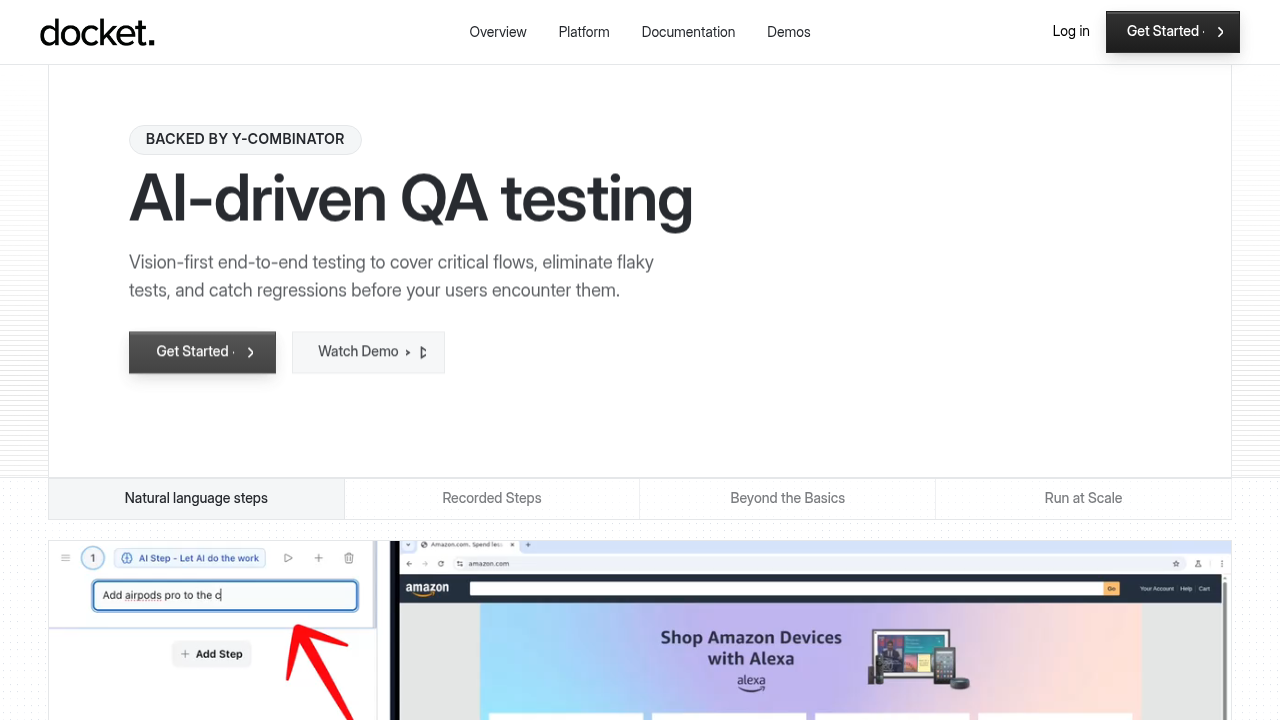
The step recorder saves and reuses common flows like login or checkout, enabling teams to build thousands of stable tests quickly. When tests fail, Docket generates visual bug reports with screenshots, console logs, network traces, and replay videos that give developers full context.
This coordinate-based approach leads to the most intuitive and reliable approach for self-healing tests. While DOM-based tools search for alternative selectors when elements change, Docket never relies on fragile selectors to begin with. Tests require virtually zero maintenance compared to traditional automation frameworks.
Mabl
Mabl is a low-code test automation solution that uses machine learning to provide auto-healing capabilities for UI tests. The browser-based trainer interface allows teams to record tests without extensive coding, while ML algorithms automatically adjust to minor UI changes by finding alternative DOM selectors when primary ones fail.
The tool includes cross-browser and API testing capabilities with integration into CI/CD pipelines and DevOps workflows. Teams already invested in DOM-based testing can add AI-powered healing to reduce some maintenance burden from incremental UI updates.
However, Mabl's approach still relies fundamentally on DOM selectors. The ML algorithms search for alternative locators when elements change, which requires identifiable attributes in the DOM. This breaks down with canvas-based applications, dynamic UIs, or significant layout restructuring where alternative selectors cannot be reliably determined. Teams testing complex or frequently changing interfaces will still face maintenance overhead compared to vision-based approaches.
testRigor
testRigor is a codeless test automation solution that allows teams to write tests in plain English using natural language. The approach reduces technical barriers by accepting instructions like "click the Sign In button" rather than requiring code or selector knowledge.
The tool provides cross-platform coverage for web, mobile, API, and desktop applications. Self-healing capabilities automatically adapt to minor UI changes, while Vision AI validates image-based elements. Teams can generate tests from app descriptions, accelerating initial test creation.
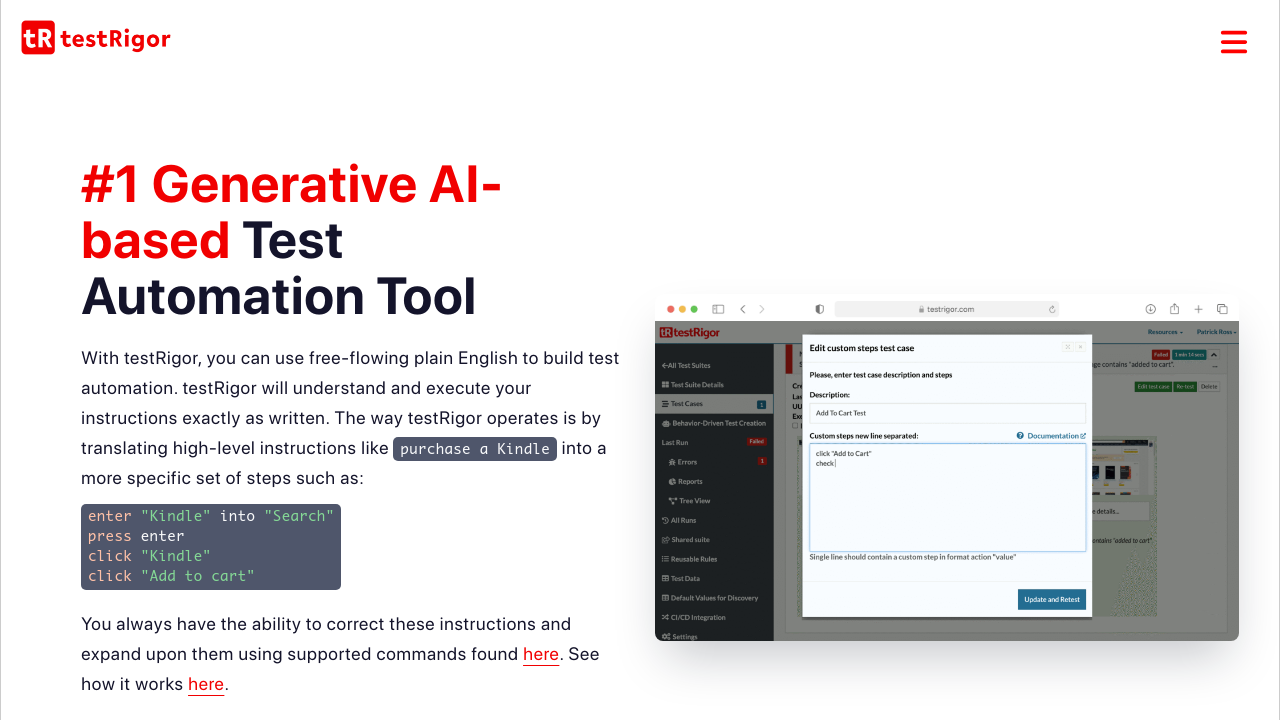
testRigor identifies elements based on visible text rather than traditional selectors. This creates limitations when multiple elements share identical text or when text changes frequently across releases. The tool also requires manual specification of each interaction rather than offering autonomous test execution.
testRigor democratizes test creation through natural language but lacks the autonomous, agentic capabilities needed for truly self-maintaining tests at scale.
Tricentis Tosca
Tricentis Tosca is an enterprise test automation solution that uses a model-based approach with Vision AI capabilities. The system supports test case design, test automation, and continuous testing through a codeless drag-and-drop interface that integrates with CI/CD pipelines and enterprise workflows.
Vision AI employs machine learning to test remote desktops using visual cues rather than traditional selectors. The model-based architecture allows teams to create reusable test components through object repositories that abstract technical implementation details.
Tricentis serves large enterprises with complex SAP environments and established QA teams who need comprehensive test management alongside automation. The solution handles intricate enterprise workflows and provides robust governance features for organizations with stringent compliance requirements.
However, Tricentis bolts AI capabilities onto a fundamentally DOM-based architecture rather than building vision-first from the ground up. The model-based approach requires significant upfront investment in creating and maintaining object repositories, and Vision AI is limited to specific use cases rather than serving as the core testing approach. Teams still face maintenance burden when applications change because the underlying architecture remains dependent on traditional element identification methods.
Feature Comparison Table of Self-Healing Test Automation Tools
The table below compares core self-healing capabilities across the four tools evaluated in this article. These dimensions reveal fundamental differences between vision-based and DOM-based approaches to test resilience.
Why Docket Is the Best Self-Healing Test Automation Tool
Docket eliminates test maintenance by solving the problem at its foundation rather than working around it. DOM-based tools with self-healing capabilities still break when selectors become invalid, then attempt recovery through backup locators or machine learning. This reactive approach reduces maintenance but cannot eliminate it.
Docket's coordinate-based architecture never uses selectors in the first place. The AI agents interact with applications through visual recognition and screen coordinates, understanding what users intend to accomplish rather than tracking implementation details. When developers restructure code, redesign interfaces, or refactor components, Docket's tests continue executing because they operate independently of the DOM structure.
This distinction becomes critical for teams testing canvas-based applications, dynamic UIs, or products with frequent interface updates. While other tools require workarounds or manual intervention for complex interfaces, Docket handles them natively through its vision-first approach.
The autonomous agents also reduce the test creation burden. Instead of recording brittle click sequences or writing selector-based scripts, teams provide natural language instructions that remain valid through application changes. This combination of intelligent execution and resilient architecture delivers what self-healing tools promise but cannot fully achieve: tests that genuinely require zero maintenance.
Final thoughts on reducing test maintenance
QA automation that relies on visual recognition instead of DOM selectors eliminates the root cause of test breakage. Self-healing tools reduce maintenance time, but vision-first approaches remove it almost completely. Your team can focus on expanding coverage and catching real bugs instead of chasing down selector updates after every deployment.
FAQ
How do you choose between vision-based and DOM-based self-healing tools?
Vision-based tools like Docket identify elements by screen coordinates and visual appearance, making them resilient to code changes and capable of testing canvas-based UIs. DOM-based tools rely on selectors with ML fallbacks, which work for traditional web apps but still require maintenance when attributes change significantly.
Which self-healing test automation tool works best for teams without dedicated QA engineers?
Tools with natural language test creation like Docket and testRigor allow non-technical team members to write tests without coding. Docket's autonomous agents require less manual specification of each step, while testRigor needs explicit instructions for every interaction.
When should teams consider switching from traditional test automation to self-healing tools?
Teams spending more than 10 hours per week fixing broken tests after deployments or running frequent releases with dynamic UIs will see immediate value. Self-healing becomes critical when test maintenance overhead prevents expanding test coverage or slows down release velocity.
Can self-healing tools handle canvas-based applications and dynamic interfaces?
Vision-based tools like Docket handle canvas applications natively because they interact through coordinates rather than DOM elements. DOM-based self-healing tools struggle with canvas UIs, dynamic content, and significant layout changes because they depend on identifiable HTML attributes for element location.
What's the difference between reactive and proactive self-healing approaches?
Reactive self-healing detects broken selectors after changes occur, then searches for alternative locators through ML algorithms. Proactive approaches like Docket's coordinate-based system avoid selector dependency entirely, understanding user intent rather than tracking implementation details, which eliminates maintenance before it happens.
.svg)

.png)

