.svg)
.svg)

.png)
.png)

You're probably evaluating TestSigma because you want to reduce the scripting burden on your QA team. Before committing, it's worth understanding how a testing platform comparison between TestSigma and Docket reveals two fundamentally different approaches. TestSigma abstracts code into natural language, but the underlying logic still relies on DOM queries and selectors. Docket is the only fully vision-based QA automation platform, meaning it interacts with software through x-y coordinates and on-screen visuals rather than brittle DOM selectors. This makes it uniquely capable of testing canvas-based, dynamic, or otherwise complex UIs that traditional tools cannot handle.
TLDR:
- Docket uses vision-based AI agents that interact via x-y coordinates, not DOM selectors
- Tests self-heal when UI changes because agents locate elements visually, not by code structure
- Vision-first approach handles canvas-based and dynamic UIs that selector tools cannot test
- Bug reports include video replays, network traces, and console logs for faster debugging
- Docket tests web apps through autonomous agents that validate real user experience end-to-end
What is TestSigma?
TestSigma offers a cloud-native environment for automating web, mobile, and API tests. Rather than relying on code-heavy frameworks, it permits users to define test steps using plain English with no-code test automation. Rather than relying on code-heavy frameworks, it permits users to define test steps using plain English with no-code test automation. This abstraction allows manual testers and product owners to build automation logic without managing complex syntax.

The platform maps text commands directly to executable actions through its natural language processing layer. A user inputs "Click on Login Button," and the system translates this intent into browser or mobile interface events. This removes the immediate need for Java or JavaScript scripting, offering a shallower learning curve than standard Selenium setups.
Core technical features include:
- Cloud Infrastructure: Users execute tests in parallel on managed servers, removing the requirement for local device farms.
- CI/CD Integration: Native connectors for Jenkins, CircleCI, and Slack trigger runs within deployment pipelines.
- Data-Driven Testing: The system accepts external data sets to validate logic variances across different browser environments.
To handle DOM volatility, TestSigma applies AI to selector maintenance. If an element's ID or attribute shifts, the system attempts to self-heal by identifying the target through alternative properties. This logic reduces the breakage often seen in rigid selector-based automation, keeping suites stable as the application UI evolves.
What is Docket?
Docket is an AI-powered QA automation platform that deploys autonomous browser agents to validate web and mobile applications end-to-end. Rather than checking technical assertions like traditional tools, Docket simulates complete user journeys to validate actual user experience. Agents execute workflows, interact with elements visually, and identify both functional regressions and UX issues that would block or confuse real users.
Agents execute workflows, interact with elements visually, and identify both functional regressions and UX issues that would block or confuse real users. This approach allows the system to test dynamic frontends, including canvas-based applications, by processing the visual output rather than the underlying HTML. Because interactions rely on semantic intent, tests avoid the brittleness typical of standard automation. If a button is restyled, the agent adapts to locate the correct element, reducing maintenance.
Core capabilities include:
- Vision-Based Interaction
Agents navigate via visual cues, removing dependency on fragile CSS or XPath selectors. - Natural Language Authoring
Engineers define tests using plain English or by recording sessions, eliminating proprietary scripting. - Self-Healing Execution
The system detects UI changes and adjusts paths automatically to keep builds green. - Rich Debugging
Failures generate structured visual bug reports with screenshots, console logs, network traces, replayable videos, and full context for developers making it easy to understand what went wrong and fix issues faster. - Exploratory Testing Capability
Agents can discover issues and edge cases beyond predefined test scenarios, uncovering unexpected problems that manual test planning might miss.
Test Creation and Maintenance
The core difference lies in how these tools translate human intent. One relies on syntax parsing, while the other applies visual observation.
Authoring Workflows
TestSigma uses a structured parser. Users input commands like "Enter email," which convert to Selenium-style commands targeting specific DOM elements. While this removes coding requirements, it remains bound to HTML structure. Users must format commands for the parser, effectively learning a specific syntax to run tests.
Docket accepts high-level intent. An AI agent interprets plain English instructions, such as "Log in and purchase item," interacting via computer vision and x-y coordinates. No translation to CSS selectors occurs. The agent identifies visual elements directly, removing the need for rigid syntax.
Resilience to Change
TestSigma handles maintenance with self-healing attributes. If a primary ID selector fails, the system tries secondary attributes like XPaths. This often fails during significant UI refactors or logic shifts.
Docket ignores the DOM. Because the agent operates on visual context, HTML structure changes do not affect stability. Whether a button moves or changes tags, the agent adapts if the visual intent remains clear, preventing broken scripts after deployments.
Handling Complex and Dynamic UIs
TestSigma covers web, mobile, and APIs, yet its architecture remains tethered to the Document Object Model (DOM). For standard forms, this functions adequately. However, when applications use dynamic class generation, Shadow DOMs, or custom component libraries, the tool often fails to maintain stable hooks. If the code structure lacks explicit tags, the automation loses track of its target, forcing engineers to manually inject attributes into production code.
This limitation prevents native interaction with canvas-based applications. Since elements drawn inside an HTML5 <canvas> tag do not exist as distinct DOM nodes, TestSigma cannot detect individual components without brittle JavaScript workarounds.
Docket bypasses the code layer entirely. By using a vision-first, coordinate-based model, the AI agent interacts with the interface based strictly on visual output. This makes it uniquely suited for dynamic single-page applications where HTML shifts rapidly.
This approach resolves the canvas issue. Whether testing a WebGL design tool or an interactive chart, Docket identifies elements visually and interacts via x-y coordinates. It validates functionality based on what the user sees rather than querying a document object, allowing automation for interfaces that remain invisible to selector-based tools.
Integration and Workflow
TestSigma links to CI/CD providers and bug tracking systems, offering a cloud device lab for browser validation. While it supports external connections, the test assets remain confined. Users cannot export tests as independent code files. This architecture forces teams to maintain their full suite within the proprietary interface, restricting migration options and creating dependency on the vendor's environment.
Docket focuses on diagnostic speed within existing workflows. It connects with CI/CD pipelines and issue trackers like Linear, Jira, and Slack. Instead of generic failure logs, the AI agent produces detailed visual bug reports. Each report contains the exact state of the application at the moment of failure, giving engineers the context needed to fix regressions without manual reproduction:
- Replayable Video: Watch the exact steps the agent took leading up to the error.
- Network Traces: Inspect API calls and responses during the failing run.
- Console Logs: Review browser-level errors and warnings.
- Visual Snapshots: High-resolution capture of the UI state.
Why Docket is the Better Choice
TestSigma targets large teams requiring a single interface for native mobile, API, and web automation managed through cloud device farms. It serves as a generalist tool for organizations prioritizing governance across disparate testing environments. However, its reliance on DOM-based locators means that even with low-code inputs, tests remain susceptible to breakage when underlying frontend code shifts.
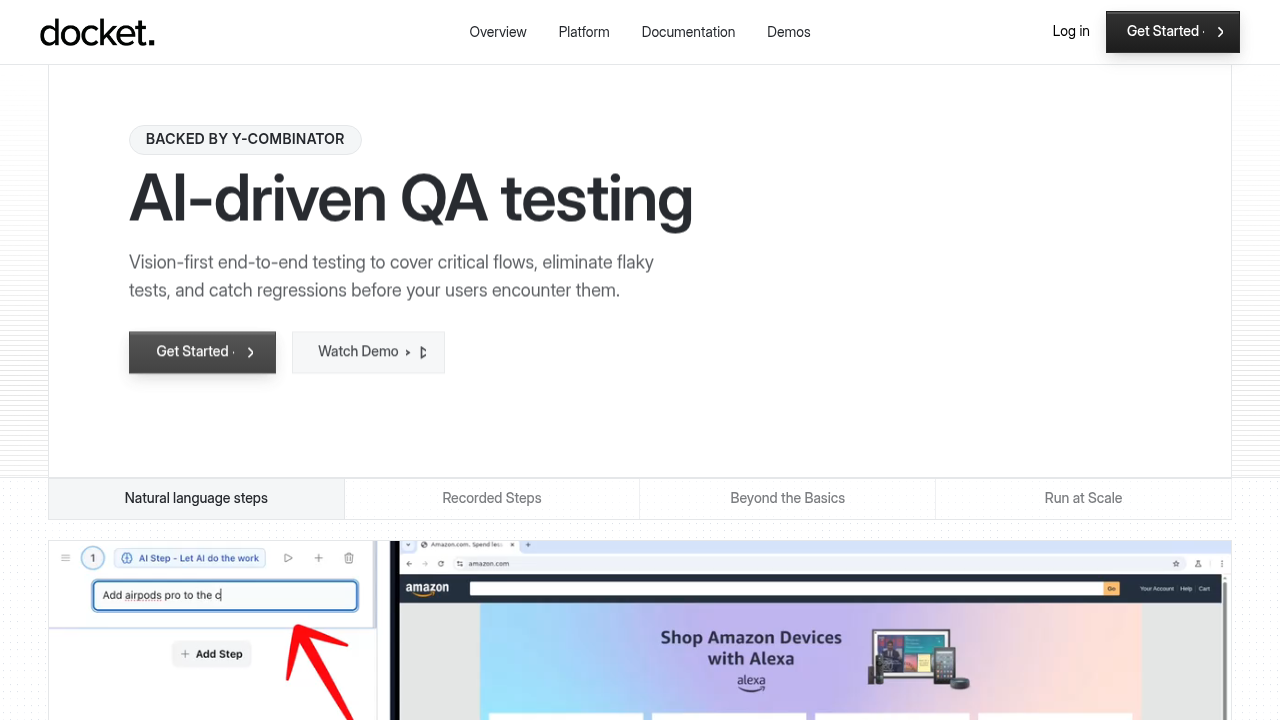
Docket is the pragmatic choice for engineering teams focused on web and mobile application stability. By deploying high-fidelity computer vision and AI agents, Docket decouples automation from the DOM entirely. Tests execute based on visual cues, buttons, forms, and layouts, rather than brittle CSS selectors or XPaths. This approach removes the maintenance overhead typical of traditional automation; if a human can see the element, the test passes. Given that 40% of companies experience at least one critical software failure every quarter and teams spend 30-50% of sprint cycles firefighting defects, eliminating test maintenance frees engineering capacity for feature development.
For functional web testing, Docket verifies the actual user experience rather than the code implementation, offering true autonomy over script maintenance.
Final Thoughts on Docket vs TestSigma
The Docket vs TestSigma decision centers on maintenance overhead. TestSigma reduces coding requirements but keeps you tied to HTML structure, meaning refactors still require test updates. Docket's AI agents validate what your users see, not what your code contains, so your test suite survives frontend changes without manual intervention. This vision-based approach aligns with broader industry momentum: the global AI visual inspection system market reached $24.1 billion by 2024 and is projected to reach $69.06 billion by 2029, with a CAGR of 23.43%.
FAQs
How should I decide between TestSigma and Docket for my team?
If your team needs cross-platform coverage for native mobile apps and API testing through a managed device farm, TestSigma provides that breadth. If your focus is web application quality and you want tests across web and mobile that survive UI changes without constant maintenance, Docket's vision-based approach removes the DOM dependency that causes most test breakage.
Can Docket test canvas-based applications that TestSigma cannot handle?
Yes. Because Docket uses x-y coordinates and computer vision instead of DOM selectors, it can interact with elements rendered inside HTML5 canvas tags, including WebGL tools, interactive charts, and dynamic design interfaces. TestSigma requires DOM nodes to function, making canvas testing impractical without custom JavaScript workarounds.
Who is each tool best suited for?
TestSigma fits large organizations that need governance across web, mobile, and API testing in a single cloud environment. Docket is built for engineering teams shipping web applications frequently, where test maintenance overhead from UI changes would otherwise slow down releases or require dedicated QA engineers to fix broken selectors.
What happens to my tests if I need to migrate away from TestSigma?
TestSigma does not export tests as standalone code files. All test assets remain inside the proprietary platform, creating vendor lock-in. If migration becomes necessary, teams must rebuild their suite from scratch in the new tool.
How long does it take to get Docket running in a CI/CD pipeline?
Most teams integrate Docket into their deployment pipeline within hours. The system connects directly to Jenkins, CircleCI, and similar tools, and because tests are written in plain English or recorded visually, there is no scripting setup required before the first run.
.svg)

.png)

