
.svg)
.svg)


.png)
.png)

The days of writing brittle test scripts for every checkout scenario are behind us. Most teams still use checkout flow testing that depends on CSS selectors and element IDs, which means every UI update breaks something. For e-commerce companies where a broken payment button costs real revenue, that maintenance overhead isn't just annoying. It's expensive.
TLDR:
- AI-powered QA tools catch checkout bugs before customers do, protecting the $260B lost to cart abandonment.
- Vision-based testing uses coordinates instead of DOM selectors, staying stable through UI changes.
- Docket's autonomous agents test checkout flows in plain English and self-heal when code updates.
- Traditional tools like Playwright and Cypress break with every frontend change, requiring constant maintenance.
- Docket detects UX friction that blocks conversions, not just technical pass/fail checks.
What is AI-Powered QA Testing for E-commerce Checkout Flows?
AI-powered QA testing employs autonomous agents to validate purchasing journeys through computer vision rather than brittle DOM selectors. Traditional automation often fails in checkout environments where third-party iframes such as payment gateways or shipping calculators, which load dynamically or lack accessible code identifiers.
These tools interact with the application surface visually, clicking based on coordinates and context. By decoupling the test from the underlying code, AI agents navigate flows involving discount logic and guest checkouts without failing due to minor UI updates. This method detects revenue-impacting errors while reducing the maintenance burden typical of regression scripts.
How We Ranked AI-Powered QA Testing Tools for E-commerce
This evaluation ranks tools by technical architecture and verifiable capabilities. With nearly 70% of carts abandoned, the primary metric is reducing technical friction in payment funnels.
Key Evaluation Criteria
- Vision-Based vs. DOM-Based: Checkout flows frequently use dynamic third-party iframes like Stripe or PayPal. Tools dependent on brittle CSS selectors fail here, while vision-based agents maintain stability.
- Self-Healing: Scripts must adapt to UI updates automatically to remove manual maintenance overhead.
- Creation Velocity: Rankings favor natural language inputs that scale coverage without consuming engineering hours.
- Checkout Logic: Handling complex validations, dynamic shipping calculations, and 2FA is required.
- Debugging Context: Failure reports must include network logs, console errors, and session video for rapid triage.
Best Overall AI-Powered QA Testing Tool for E-commerce Checkout Flows: Docket
Docket operates as a vision-based AI QA tool designed to validate checkout flows through autonomous browser agents. While legacy automated testing tools depend on brittle DOM selectors that break with minor frontend updates, Docket uses coordinate-based automation and computer vision to interact with applications. This approach simulates true user behavior, keeping tests resilient to UI iterations and removing the maintenance overhead often associated with script-based e-commerce testing.
Key Features
- Vision-First Architecture: Docket agents navigate using x-y coordinates rather than code-based selectors. This allows the system to test canvas-based elements or complex checkout UIs that standard automated testing tools fail to recognize.
- Natural Language Test Creation: Teams build checkout flow testing logic by describing objectives in plain English (e.g., "select standard shipping and pay with Visa"), eliminating the need for complex code.
- Self-Healing Agents: The AI agents visually interpret UI changes and adapt execution paths automatically, preventing test failures after frontend deployments.
- UX Issue Detection: The system flags friction points such as unresponsive buttons or confusing layouts that hurt conversion optimization, going beyond simple functional pass/fail checks.
- Visual Debugging Context: Reports include network traces, screenshots, and replayable videos, allowing engineers to reproduce and patch bugs immediately.
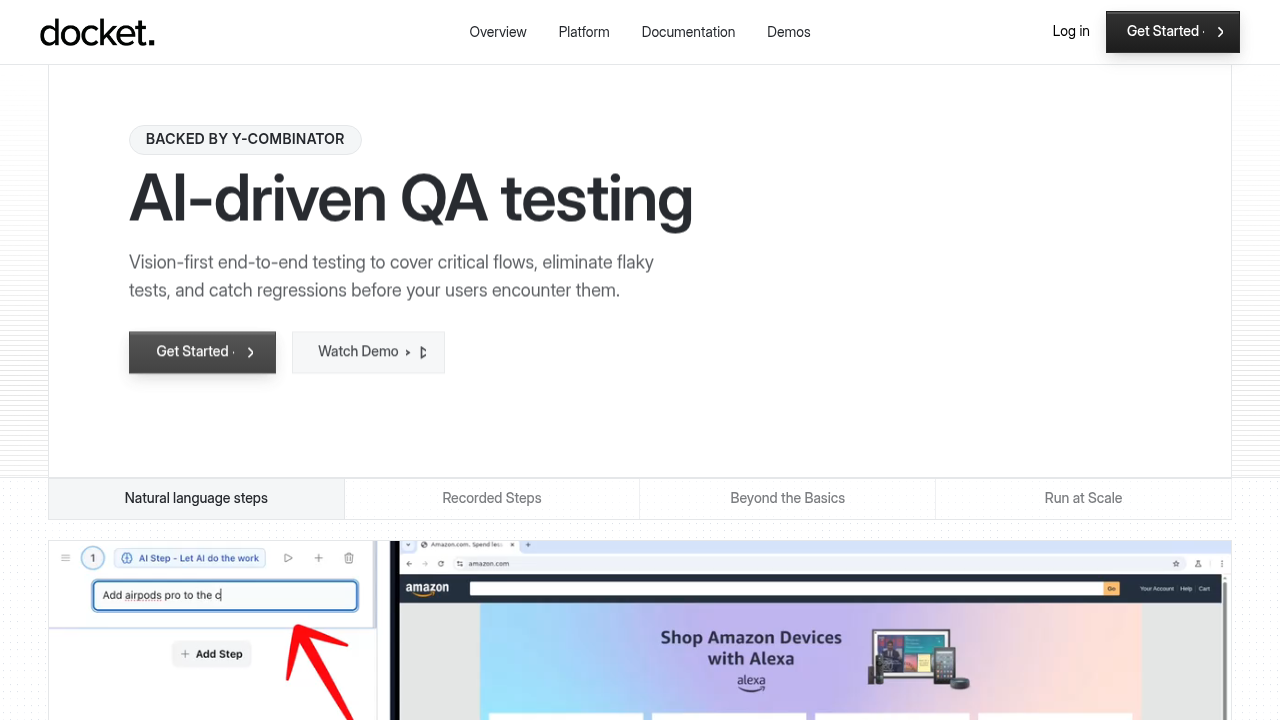
Good for: E‑commerce teams running frequent releases that need resilient, end‑to‑end checkout coverage (including third‑party payment providers) without maintaining brittle selector-based scripts.
Limitation: Best suited to web checkout flows where visual rendering is available; highly API-only or back‑office test scenarios still require complementary, non-visual automation.
Bottom line: Docket gives revenue-focused teams low‑maintenance, high‑reliability checkout testing by combining vision-based agents, natural language scenarios, and UX-friction detection to catch conversion-killing bugs before customers do.
ContextQA
ContextQA handles web application testing by recording user sessions and converting them into executable scripts. This approach allows QA engineers to verify cart functionality and payment gateways across different environments by replaying specific user paths.
Key Features
- Logs inputs and navigation paths to establish baseline scenarios.
- Converts recorded sessions into repeatable cases to reduce manual coding.
- Connects with CI/CD pipelines to run validation checks during deployment.
- Checks consistency across multiple browser engines for stability.
Good for: Teams that prefer defining specific click interactions via recording tools rather than writing code.
Limitation: The system requires granular step definitions. It lacks autonomous agents that interpret high-level intent, meaning engineers must map every action in the funnel rather than instructing the system to reach a goal.
Bottom line: ContextQA fits teams focused on detailed script recording. Docket provides an alternative using a Step Recorder and autonomous AI agents, allowing for objective-based test creation that adapts to dynamic e-commerce interfaces without rigid selector dependencies.
Tricentis
Tricentis offers enterprise test automation software that layers AI features onto a traditional testing framework. It focuses on scaling validation across corporate environments using risk-based assessments.
What They Offer
- DOM-based identification uses code-based object recognition rather than visual coordinates.
- Multi-app support covers web, mobile, and desktop applications.
- Risk-based optimization ranks tests by business risk to validate critical paths.
- Enterprise integrations connect with standard development pipelines.
Good for: Large enterprises needing broad coverage across varied application types.
Limitation: The system depends on DOM selectors, which break when checkout UIs change or use dynamic IDs. The AI capabilities lack the vision-based adaptability required for frequent updates.
Bottom line: Tricentis suits enterprise-wide strategies. In contrast, Docket uses a coordinate-based architecture and native AI agents, offering greater resilience for checkout flows by removing selector maintenance.
Mabl
Mabl merges automated UI and API validation in a cloud-hosted environment. It applies machine learning to support test stability and includes a visual builder for non-technical team members.
- DOM-based auto-healing attempts to repair broken element selectors using historical execution data.
- Low-code recording permits users to construct tests via a visual interface.
- Unified workflows execute API and UI validation steps in a single run.
- Managed infrastructure runs tests remotely without local environment configuration.
Good for: Teams that want a cloud-hosted, low-code platform to run combined UI and API tests with a visual recorder and integrated reporting, without managing test infrastructure themselves.
Limitation: Relies on DOM selectors and auto-healing, which can still lead to flaky tests and ongoing maintenance when UIs change frequently, especially in dynamic e-commerce frontends.
Bottom line: Mabl works for teams requiring integrated cloud execution. The primary limitation remains reliance on DOM selectors, which often fail during rapid e-commerce UI updates. Docket avoids this instability by using vision-first agents that interact via coordinates rather than code attributes.
Stably AI
Stably AI operates as a generative layer for Playwright, translating requirements into executable test scripts. It keeps teams within the Playwright ecosystem while reducing manual coding time.
Key Capabilities
- Generative Scripting: Creates Playwright code from plain English descriptions.
- Framework Compatibility: Outputs standard code that fits existing CI/CD pipelines.
- Requirement Parsing: Translates text-based logic into test assertions.
Good for: Engineering teams committed to Playwright wanting to hasten initial test creation.
Limitation: The generated output relies on DOM selectors. While creation accelerates, the resulting scripts suffer from the same brittleness as manually written ones. UI changes in a checkout flow often break these selectors, demanding manual debugging.
Bottom line: Stably AI generates brittle code faster. Docket removes the script entirely with vision-based agents, eliminating the maintenance burden inherent in selector-based automation.
Spur
Spur targets test automation for e-commerce retailers, allowing teams to capture and replay user journeys. It verifies online store functionality by executing predefined sequences against product pages and checkout flows.
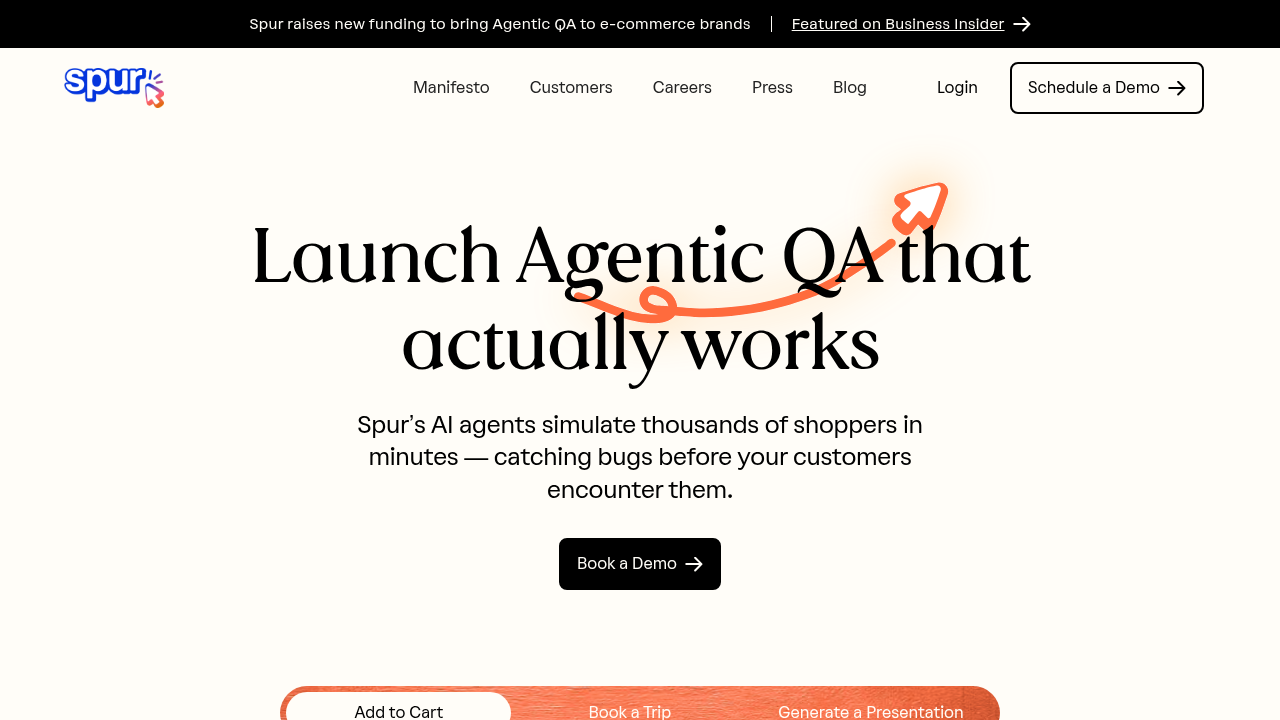
What They Offer
- Retail-focused validation designed for common e-commerce scenarios
- Flow recording to capture checkout steps for playback
- Automated execution to check for system stability
- Integration support for standard e-commerce site architectures
Good for: Teams needing retail-specific tooling who accept manual step specification.
Limitation: The system relies on users defining every click and input. It lacks autonomous agents that interpret high-level objectives, forcing engineers to map granular paths instead of describing goals.
Bottom line: Spur fits e-commerce but demands rigid instruction. Docket provides a Step Recorder for repetition and autonomous AI agents that solve described objectives without manual oversight.
Feature Comparison Table of AI-Powered QA Testing Tools
Evaluating automated testing tools involves analyzing how specific architectures handle e-commerce complexity. The following comparison distinguishes between vision-first autonomous agents and traditional frameworks dependent on DOM selectors.
Why Docket is the Best AI-Powered QA Testing Tool for E-commerce Checkout Flows
Docket resolves the instability inherent in standard automated testing tools by eliminating dependencies on code-based selectors. Instead of parsing the DOM, Docket agents operate through a vision-first model, using x-y coordinates and visual context to interact with the interface. This approach proves critical for testing dynamic components like third-party payment iframes and canvas-based renderers that typically fracture script-based tests.
Because the system learns intent rather than specific element IDs, checkout flow testing remains resilient during frontend updates. This reliability defends against the $260 billion in recoverable lost orders attributed to checkout friction. By catching functional errors and UX anomalies pre-production, engineering teams deploy with confidence, reducing the maintenance overhead that plagues legacy testing frameworks.
Final Thoughts on AI-Powered QA Testing for Checkout Flows
Checkout flows demand testing that survives UI updates and third-party integrations. Checkout flow testing using vision-based agents removes the selector brittleness that causes script failures after every frontend change. Your QA coverage stays reliable, your engineers stop debugging flaky tests, and you catch conversion-killing bugs before customers do.
FAQs
How do I choose the right AI QA testing tool for my e-commerce checkout flow?
Prioritize tools that handle dynamic third-party iframes (payment gateways, shipping calculators) without breaking. Vision-based systems that use coordinates instead of DOM selectors maintain stability through UI changes, while natural language test creation reduces engineering overhead for teams shipping frequently.
Which AI testing tool works best for teams without dedicated QA engineers?
Tools offering natural language test creation and autonomous agents allow non-technical team members to define checkout scenarios without writing code. Vision-based platforms remove the maintenance burden of selector-based scripts, making them accessible to product managers or support teams validating user flows.
Can AI testing tools detect UX issues that hurt conversion rates?
Some platforms flag friction points beyond functional errors such as unresponsive buttons, confusing layouts, or multi-step flows that frustrate users. Traditional tools verify technical assertions (element present, API returns 200), while user-centric systems evaluate whether a real customer would complete the purchase successfully.
When should I switch from DOM-based testing to vision-based automation?
If tests break after every frontend deployment or third-party checkout widgets cause flaky failures, vision-based tools eliminate selector maintenance. Teams shipping daily or using canvas-based UIs see immediate value from coordinate-based agents that adapt to UI changes automatically.
What debugging information should an e-commerce testing tool provide?
Failure reports must include network traces, console errors, screenshots, and session replay videos. This context allows engineers to reproduce payment gateway errors or shipping calculation bugs immediately, reducing triage time from hours to minutes during critical checkout incidents.
.svg)
.png)

