.svg)
.svg)


.png)
.png)

You're probably comparing LambdaTest vs Docket because you need better test coverage, but the bigger problem is test maintenance. LambdaTest provides the infrastructure to execute your Selenium or Playwright scripts at scale, which is great if your selectors are stable. Docket removes the selector problem entirely by using AI agents that interact visually, clicking coordinates instead of hunting for DOM elements. When your UI changes, the agent adjusts automatically.
TLDR:
- LambdaTest runs Selenium/Playwright scripts across browsers but breaks when DOM selectors change.
- Docket uses vision-based AI agents that test via x-y coordinates, eliminating selector maintenance.
- Vision-first testing handles complex UIs like Canvas and SPAs that DOM-based tools can't reliably test.
- Docket self-heals when layouts shift, while LambdaTest requires manual script updates after UI changes.
- Docket is an AI-powered QA solution using autonomous agents to test web apps through visual recognition.
What is LambdaTest?
LambdaTest provides cloud-based infrastructure for executing automated tests. It supports scripts written in standard frameworks like Selenium, Playwright, Cypress, and Appium, allowing engineers to run code against a matrix of browser and operating system combinations. This infrastructure removes the need to maintain local servers or device labs, shifting focus to parallel execution and cross-browser validation. It functions as a scalable runtime environment for pre-existing test suites.

What is Docket?
Docket is an AI-powered QA automation solution that uses autonomous browser agents to test web applications end-to-end, the way a real user would. Instead of relying on brittle DOM selectors or scripted tests, Docket interacts with applications visually using on-screen context and x-y coordinates.
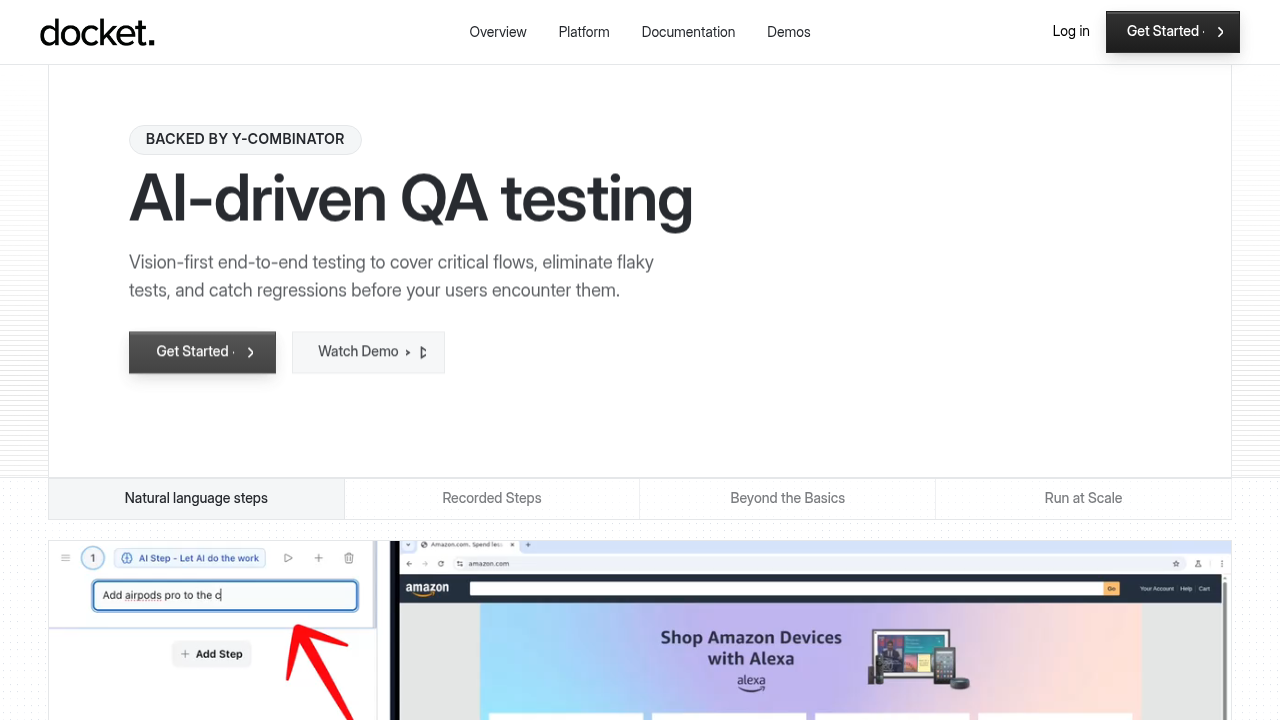
Tests are created using natural language or by recording real user flows, not by writing Selenium, Cypress, or Playwright code. Because Docket operates at the visual layer, tests stay stable when frontend code or layouts change and can reliably validate constantly changing interfaces like SPAs and Canvas-based UIs.
When a test fails, Docket generates clear, structured bug reports with screenshots and context, helping teams understand what actually blocked the user. Docket is no-code, cloud-based, and integrates into CI/CD pipelines, making it easy for product, QA, and engineering teams to maintain continuous end-to-end coverage without maintaining fragile test suites.
Test Creation and Maintenance
LambdaTest provides the cloud infrastructure to execute scripts you write elsewhere. Your team handles the authoring in frameworks like Selenium or Playwright, binding tests to specific DOM elements such as IDs, XPaths, or CSS classes. This structure demands ongoing engineering input. When a UI component changes or a class name updates, hard-coded selectors fail, requiring manual intervention to get the build green again.
Docket replaces this selector dependency with vision-based AI. Our agent interacts with the application by analyzing visual context and coordinates, interpreting the screen like a human user. You define objectives via natural language or recording, and the agent executes the path. Because the system relies on visual intent instead of code-level attributes, tests persist through layout changes without breaking.
- LambdaTest: Ideal for teams needing scalable cloud execution for mature, code-heavy test suites.
- Docket: Built for teams focused on reducing maintenance through autonomous, visual-first testing that requires no scripting.
Test Execution Approach
LambdaTest operates as a scalable cloud grid. It runs defined scripts across parallel environments to check browser compatibility. The limitation here is the dependency on the Document Object Model (DOM). If a specific CSS class or ID changes during a deployment, the script breaks. The test fails not because the feature is broken, but because the strict code reference is missing.
Docket uses autonomous AI agents that rely on computer vision. The agent ignores the DOM structure and scans pixels to identify elements by context. It calculates specific coordinates to interact with the application. This allows the test to persist even if the underlying code changes; if a button moves to a new location, the agent sees it and adjusts the interaction target automatically.
See table below for testing platform comparison of Docket and LambdaTest features.
LambdaTest confirms that scripts run across a rigid infrastructure. Docket confirms the application actually works for a human. Visual navigation identifies functional errors and layout bugs that script-based grids overlook.
Handling Complex UIs
LambdaTest relies on scripts tied strictly to the DOM. This causes failures when testing SPAs or interfaces that change often. React and Vue frequently generate random class names during hydration; if a target class changes during a re-render, the test breaks even if the feature works. HTML5 Canvas elements further complicate this by hiding internal structures from the DOM, preventing Selenium from inspecting components without fragile workarounds.
Docket interacts via visual recognition and x-y coordinates. The AI agent interprets screen pixels instead of parsing tags or IDs. This makes testing Canvas-based applications, map interfaces, and dashboards reliable.
Teams with static HTML might find LambdaTest adequate. For ever-evolving interfaces, DOM selectors impose a high maintenance cost. Docket validates these environments by simulating user behavior. So, if a a user is able to see the element, the test runs regardless of the underlying code.
Why Docket is the Better Choice
LambdaTest fits teams with mature Selenium or Playwright suites requiring a secure scalable cloud grid. It handles infrastructure, allowing engineers to offload local processing and parallelize execution across browser combinations. If the goal is scaling legacy test suites, LambdaTest functions effectively as a remote runner.
However, infrastructure does not fix DOM fragility. LambdaTest executes scripts but cannot prevent them from breaking during UI updates. Engineers remain stuck debugging failed builds and patching selectors. Common browser testing challenges persist because the tool solves for runtime capacity, not test resilience.
Docket removes maintenance overhead through a vision-first, coordinate-based model. Docket's AI agent adapts to visual context instead of rigid DOM attributes, so tests self-heal when layouts shift.
Validating actual user experience takes priority over code assertions. While a script might pass technical checks on a rendering error, Docket identifies if a flow is visually unresponsive. For teams managing cross browser testing, this provides autonomous reliability without the burden of maintaining selector-based grids.
Final thoughts on LambdaTest and Docket
LambdaTest handles parallel execution for teams with mature Selenium suites. But comparing LambdaTest vs Docket shows a bigger difference in how tests break and recover. We designed Docket to interact visually, so your tests adapt when buttons move or classes change. You avoid the constant selector updates that eat into your sprint velocity.
FAQ
How should I decide between LambdaTest and Docket for my team?
If you have mature Selenium or Playwright suites and need cloud infrastructure for parallel execution across browser combinations, LambdaTest provides that runtime environment. If you're spending a lot of time fixing broken selectors after UI changes or testing evolving interfaces (SPAs, Canvas elements), Docket's vision-based approach removes that maintenance burden entirely.
What's the core technical difference between how LambdaTest and Docket run tests?
LambdaTest executes your existing scripts that rely on DOM selectors (IDs, XPaths, CSS classes) across a cloud grid. Docket uses AI agents that interact via x-y coordinates and visual recognition, bypassing the DOM entirely. So, Docket tests adapt when layouts change instead of breaking.
Who is LambdaTest best suited for versus Docket?
LambdaTest fits teams with mature code-heavy test suites who need scalable cloud execution and already have engineering resources dedicated to test maintenance. Docket is built for teams managing complex state based UIs (React, Vue, Canvas-based apps) who want to reduce or eliminate selector maintenance while validating actual user experience.
Can Docket handle our application if we're using stateful frameworks like React or building with Canvas elements?
Yes. Because Docket interacts via visual recognition and coordinates instead of parsing the DOM, it handles dynamically generated class names, Canvas elements, and complex SPAs without the fragility that breaks selector-based tools when components re-render or shift position.
What's involved in migrating from a LambdaTest setup to Docket?
You won't port existing scripts. Docket replaces selector-based code with natural language instructions or recorded flows. The shift is from maintaining Selenium/Playwright scripts to defining test objectives that AI agents execute visually. Docket offers hands-on onboarding to help build your initial test suite, typically getting teams running in hours as opposed to weeks.
.svg)

.png)

